How to Cite a Google Map: The Complete APA & MLA Reference Guide
Citing a map sounds like it should be simple. It isn't. Ask a room full of graduate students how to cite google maps in apa format and you'll get at least three confident, contradictory answers. Part of the problem is that most citation guides were written for printed atlases, not for an interactive, constantly-updating web application. A reference map you pull up on your phone today can look completely different from the same coordinates six months from now so what exactly are you citing?
This guide walks through how to cite a map, a Google Maps screenshot, and a Google Earth image, in both APA 7th edition and MLA 9th edition style. We'll cover the edge cases too: custom pins, satellite imagery, and embedded interactive maps, since those are where most citation mistakes actually happen.
If you only remember one thing from this article, remember this: treat Google Maps as the publisher, not the author. That single shift in thinking resolves most of the confusion people run into.
Whether you're finishing a thesis chapter tonight or double-checking a citation before submission, the formats below are broken out so you can copy the structure and drop in your own details.
How to Cite a Google Map in APA Format
APA 7th edition treats an online map the same way it treats other electronic sources: source, date, title, and retrieval information, in a specific order. Google itself is credited as the corporate author in most cases, since individual cartographers aren't listed.
Citing Google Maps Directly
For a standard Google Maps view say, a city or a route APA style asks for the organization as author, the year, the map title (or a description functioning as a title), the label "[Map]," and the URL.
The general APA structure looks like this:
Google. (Year). Title or description of map [Map]. Retrieved Month Day, Year, from URL
For example, if you pulled up a map of a specific neighborhood, the citation would read something like: Google. (2026). Map of Wicker Park, Chicago, Illinois [Map]. Retrieved from https://www.google.com/maps/... Note that APA's 7th edition dropped the mandatory retrieval date for most sources but maps are one of the exceptions where a retrieval date is still recommended, precisely because the content changes over time.
"Students always ask if they need the retrieval date. For a static PDF, usually not. For a live map that updates its data weekly, absolutely include it, or your citation is technically citing a moving target."
Citing a Custom or Saved Map
If you built a custom map plotted your own points, drew boundaries, saved it under My Maps the citation shifts slightly. You become part of the record as the map's creator, while Google remains the platform host. A workable format:
LastName, F. (Year). Title of custom map [Map]. Google My Maps. URL
This distinction trips people up constantly: a custom map isn't "by Google" in the same sense a stock street map is. You made the editorial decisions about what to include.
Citing a Satellite or Street View Image
Satellite imagery and Street View captures carry their own wrinkle they usually credit third-party imagery providers (Maxar, Airbus, and others) in small print at the bottom of the frame. A rigorous citation acknowledges the underlying imagery source alongside Google as the platform, since that's technically who captured the data.
How to Cite Google Maps in MLA Format
MLA 9th edition citation logic runs differently from APA it's built around a "container" model, where the map sits inside the larger container of the website.
In-Text Citation
MLA in-text citations for maps are typically short author or organization name, no page number needed for a digital source without pagination. For a standard Google Maps reference, that's usually just "(Google Maps)" or a shortened title if no clear author exists.
Works Cited Entry
The full Works Cited entry for how to cite google maps mla follows this container structure:
"Title of Map." Google Maps, Google, Date Accessed, URL.
An example: "Map of Central Park, New York City." Google Maps, Google, Accessed 30 July 2026, https://www.google.com/maps/...
Notice the access date sits inside the citation rather than being optional MLA leans harder on access dates than APA does for exactly this reason: web maps aren't static documents.
"MLA's container system feels awkward at first, but it actually solves the map problem elegantly the map is the title, Google Maps is the container, and the date accessed does the work a publication date would do for a book."
Citing an Embedded or Interactive Map
For maps embedded on a third-party website say, a business's location map on their contact page cite the embedding page as the container, and note within the entry that the map itself is a Google Maps embed, since the underlying data source and the page publisher aren't the same entity.
How to Cite Google Earth
Google Earth citations follow a similar skeleton to Google Maps, with one added wrinkle: Google Earth often involves a specific imagery date, since satellite passes happen on a schedule rather than continuously.
APA Format for Google Earth
Google Earth. (Year). Location name [Satellite image]. Retrieved from URL or noted as accessed via Google Earth Pro desktop application.
MLA Format for Google Earth
"Location Name." Google Earth, Google, Imagery Date, Accessed Date.
Citing Google Earth Pro Imagery
The desktop application, Google Earth Pro, sometimes shows a specific capture date stamped directly on the imagery layer. When that date is visible, include it it's more precise than a general access date and it's the kind of detail an instructor checking sources will notice is missing if you skip it.
Common Mistakes When Citing a Map
Most citation errors aren't about format they're about which details people forget to check before they start writing.
Missing Retrieval or Access Dates
This is the single most common gap. Static sources rarely need one; maps almost always do, because the underlying data can be updated without any visible version change on the page.
Confusing the Map Title With the URL
A URL is not a title. When a map has no clear on-page title, write a brief, accurate descriptive title in brackets rather than pasting the raw link as if it were one citation styles expect a human-readable title element, not a string of query parameters.
Not Distinguishing the Platform From the Cartographer
Google Maps and Google Earth are platforms, not always the original data creators. Underlying imagery, elevation data, and some layers come from third-party providers. A careful citation acknowledges the platform you accessed the map through, while recognizing that platform and creator aren't always identical this matters more in academic and GIS-adjacent writing than in a casual blog post.
A Few More Questions Worth Answering
What Is the Title of the Map?
This trips people up more than it should. When a citation style asks for a map's title, it means the actual on-page or on-map label the name Google Maps or the map creator gave it, not the URL and not a description you invented. A Street View frame of a specific intersection, for instance, usually has no visible title at all, which is exactly when you write a short, accurate bracketed description instead of guessing at one. Check the page's header text, the layer name in My Maps, or the caption under a static export before assuming there isn't one.
What Counts as a Geographical Reference?
A geographical reference is any element that ties content to a specific physical location coordinates, a place name, a boundary, or a map itself. In citation terms, Google Maps and Google Earth function as geographical references when they're cited to support a claim about a location, a distance, or a spatial relationship in your writing. If a paper leans on a map purely to orient the reader rather than as evidence, some style guides still expect a citation; when in doubt, cite it.
How Do I Source a Map I Found Online?
Sourcing a map and citing a map aren't quite the same task, though they're related. Sourcing means tracking down who actually produced the underlying data Google, a third-party imagery provider, a government GIS office before you cite anything. For Google Maps and Google Earth, the platform itself is the source in almost every case, but check the fine print at the bottom of satellite views; that's where third-party imagery credits usually show up, and a rigorous citation should reflect them.
Building Your Own Map Citations for Local SEO
Everything above applies to academic writing citing a reference map inside a paper, thesis, or report. If you're instead trying to build a google map citation for local SEO purposes generating radius boundaries, KML layers, or service-area maps for a business listing that's a different task entirely, closer to GIS work than academic referencing.
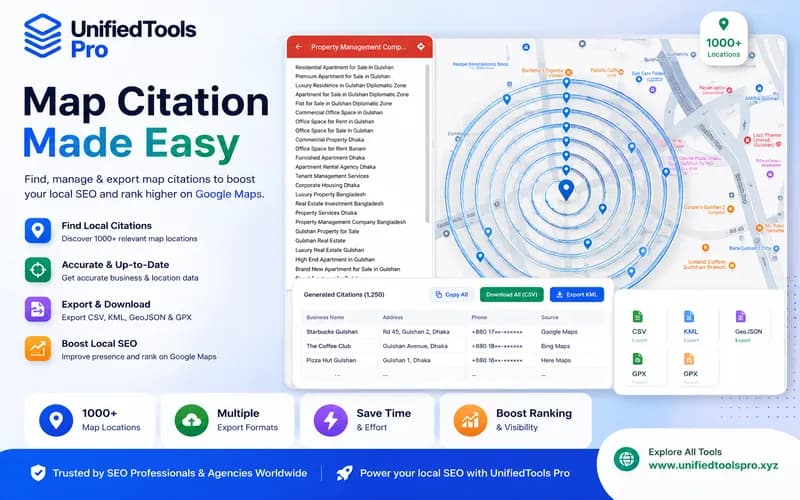
UnifiedTools Pro's free Map Citation Pro tool generates geodesic KML, GeoJSON, and GPX exports for exactly that use case: local SEO specialists building Google My Maps citation layers for client service areas. It handles the geometry and metadata fields that Google My Maps expects, so you're not manually plotting coordinates by hand.
Need to reference a map correctly in your paper? Use the formats above. Need to build a map citation for local search rankings? Try Map Citation Pro, free, at UnifiedTools Pro.
Citation formatting rewards precision over memorization once you understand why APA wants a retrieval date and MLA wants an access date baked into the entry, you stop guessing and start applying the logic to any map you come across, Google-made or otherwise.
Frequently Asked Questions
What is the difference between APA and MLA citation styles for Google Maps?
How do I cite a custom or saved map in APA format?
What is the correct way to cite a satellite or street view image in MLA format?
Try the tools in this article
101+ free tools — SEO, images, PDF, dev